Numeracy & Mathematics
At Comely Park Primary School and ELC learning in numeracy enables our children and young people to:
- develop essential numeracy skills which will allow them to participate fully in society.
- understand that successful independent living requires financial awareness, effective money management, using schedules and other related skills.
- interpret numerical information appropriately and use it to draw conclusions, assess risk, make reasoned evaluations and informed decisions.
- apply skills and understanding creatively and logically to solve problems, within a variety of contexts.
- appreciate how the imaginative and effective use of technologies can enhance the development of skills and concepts.
Numeracy: Experiences and Outcomes (Education Scotland)
How Can I Support My Child's Learning?
Parentzone Scotland’s supporting numeracy at home section has simple ideas to support your child in learning about numeracy through everyday activities.
For many of us, it’s been a long time since we were at school and learning about maths. Sometimes that can mean your child is learning things in new ways, with different names, or even things you’ve completely forgotten how to do. Oxford Owl have brought together a collection of the key Maths Skills your child will come across: number and place value, addition and subtraction, fractions, multiplication and division, statistics, ratio and proportion, measurement, telling the time, and geometry and shapes. As you explore them, you can find out more about the level of knowledge your child will be aiming for in every age group.
As well as these topics on key maths skills, Oxford Owl have also collected a range of blogs and articles, written by education experts to give you tips and hints as you learn together with your child. These include: overcomin maths anxiety, non-verbal reasoning and times tables. For a full list of articles including top tips for supporting maths learning at home, head over to their Maths Blog.
Oxford Owl also offer some helpful information to support Math at Home; including guides for key words in maths.
If you like to supplement home learning in Math further, White Rose Education offer a range of free parent and child resources including: short video lessons (filter from Early (equivalent P1) to Year 6 (equivalent P7), free downloadable workbooks which provide an extra tool for enjoying maths together; Designed for use both in class and at home, our 1-minute maths app helps children build greater number confidence and fluency; a1-minute maths app to help children build greater number confidence and fluency; and finally a mini-series 'Maths with Michael' featuring TV presenter, teacher and parent Michael Underwood and video/printable parent guides.

|
A-guide-to-place-value | [pdf 529KB] |

|
|
|
A-guide-to-subtraction | [pdf 502KB] |
|
|
|
A-guide-to-multiplication | [pdf 445KB] |
|
|
|
A-guide-to-division | [pdf 451KB] |
|
|
|
A-guide-to-fractions | [pdf 374KB] |
|
|
|
A-guide-to-algebra | [pdf 405KB] |
|
Math Mastery
Teaching maths for mastery is a transformational approach to maths teaching. When taught to master maths, children develop their mathematical fluency without resorting to rote learning and are able to solve non-routine maths problems without having to memorise procedures.
Effective learning and teaching in numeracy involves ensuring learners have secure foundations in 5 key strands of number:
- Number word sequences
- Numerals
- Number structures
- Addition and Subtraction
- Multiplication and Division
In all Falkirk Council schools and centres a concrete, pictorial, abstract (CPA) approach is embedded in the pedagogy of numeracy and mathematics lessons. This ensures that our learners develop a deep and sustainable understanding of mathematics. Children (and adults!) can find maths difficult because it is abstract. The CPA approach builds on children’s existing knowledge by introducing abstract concepts in a concrete and tangible way. It involves moving from concrete materials, to pictorial representations, to abstract symbols and problems.
CPA at a glance:
- An essential technique of maths mastery that builds on a child’s existing understanding.
- A highly effective framework for progressing pupils to abstract concepts like fractions.
- Involves concrete materials and pictorial/representational diagrams.
- Based on research by psychologist Jerome Bruner.
- Along with bar modelling and number bonds, it is an essential maths mastery strategy.
Early Number Development
NPFS Learning Together Session 1
Addition & Subtraction
NPFS Learning Together Session 2
Multiplication & Division
NOFS Learning Together Session 3
Decimals, Fractions & Percentages
NPFS Learning Together Session 4
Decimals, Fractions & Percentages 2
NPFS Learning Together Session 5
Decimals, Fractions & Percentages 3
NPFS Learning Together Session 6
Algebra
NPFS Learning Together Session 7
Problem Solving / Bar Models
NPFS Learning Together Session 8
Sumdog

Personalised math practice that learner's love. All of our pupils have their own unique username and password.
What is Sumdog?
Questions are embedded into games, with different games for different learning styles – racing games, cooking games, flying games – there’s something for everyone. Sumdog is all about personalising the experience for each child. The questions adapt to meet your child where they are. They are aligned to the Scottish Curriculum for Excellence with focussed outcomes that are selected by your child's Teacher to mirror their learning in class.
It’s available on desktop and as an app for Android or iPhone.
Read the about the evidence and impact here.
Sign up for your parent account and you’ll be asked to enter the login details your child has from our school. You’ll be able to see what they’re working on and view their diagnostic result.
Sign up and link a school account here.

Makes learning fun!
Sumdog helps children to practise regularly. Combining fun games and achievements with curriculum-aligned questions.
Rewards effort
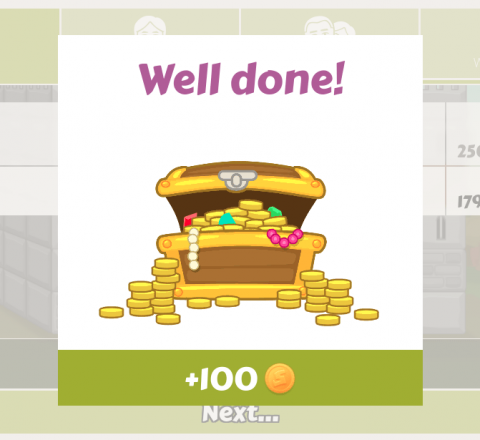
For every correct answer, children are rewarded with coins to spend on their avatar or Sumdog house. And every time a child masters a new skill, their pet learns a new trick.

Adapts to your child
Sumdog gets to know your child’s ability with an initial diagnostic and takes them through the curriculum one skill at a time. You don’t need to set their level or adjust any settings – we’ve got it all covered.