


Curriculum For Excellence at Comely Park
Scotland’s curriculum – Curriculum for Excellence (CfE) – helps our children and young people gain the knowledge, skills and attributes needed for life in the 21st century. This curriculum reflects what we value as a nation and what we seek for our young people. It is designed to convey knowledge which is considered to be important and to promote the development of values, understanding and capabilities. It is concerned both with what is to be learned and how it is taught. It should enable all of the young people of Scotland to flourish as individuals, reach high levels of achievement, and make valuable contributions to society. The four words engraved on the mace at the Scottish Parliament are – wisdom, integrity, compassion and justice. We incorporate these values in to our work at Comely Park.
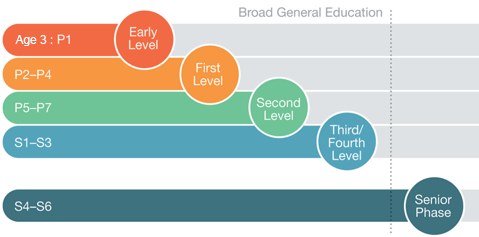
Curriculum for Excellence is divided into two phases: the broad general education and the senior phase. The broad general education begins in early learning and childcare and continues to the end of S3 (the third year of secondary school). There are five curriculum levels - Early, First, Second, Third and Fourth - in this phase. The senior phase is for young people aged 15-18 and is designed to build on the experiences and outcomes of the broad general education, and to allow young people to take qualifications and courses that suit their ability and interests.
Note: This is a general guide. Learners will progress at their own pace through the curriculum levels - the framework is designed to be flexible to permit careful planning for those with additional support needs, including those who have a learning difficulty and those who are particularly able or talented.
Scotland's Curriculum for Excellence is designed to provide the breadth and depth of education to develop flexible and adaptable young people and support them in achieving and attaining the best they possibly can. Each child has an enormous capacity for learning and the potential to achieve in different ways. As part of their learner journey, all children at Comely Park have opportunities to develop the knowledge, skills and attributes they need to adapt, think critically and flourish in today’s world. Curriculum for Excellence places learners at the heart of education. At its centre are four fundamental capacities. These capacities reflect and recognise the lifelong nature of education and learning. The four capacities are aimed at helping children and young people to become:
- Successful learners
- Confident individuals
- Responsible citizens
- Effective contributors
Pupils in Comely Park are aware of these capacities as we use them within school in structuring our work. Our celebrating success work is geared around the four capacities and our school aims are directly linked to them.
Curriculum is defined as the totality of all that is planned for children and young people from early learning and childcare, through school and beyond. That totality is planned for and experienced by learners across four contexts:
- Curriculum areas and subjects
- Interdisciplinary learning
- Ethos and life of the school
- Opportunities for personal achievement
During the broad general education, children and young people should:
- achieve the highest possible levels of literacy, numeracy and cognitive skills;
- develop skills for learning, skills for life and skills for work;
- develop knowledge and understanding of society, the world and Scotland's place in it, much of which is now included in Learning for Sustainability;
- experience challenge and success so that they can develop well-informed views and the four capacities.
There are eight curriculum areas: expressive arts, health and wellbeing, languages (including English, Gàidhlig and Gaelic learners and modern languages), mathematics, religious and moral studies, sciences, social studies and technologies.
Each curriculum area is planned using experiences and outcomes. These describe the knowledge, skills, attributes and capabilities of the four capacities that young people are expected to develop.
Curriculum for Excellence benchmarks set out clear statements about what learners need to know and be able to do to achieve a level across all curriculum areas.
Learning in the broad general education may often span a number of curriculum areas (for example, a literacy project planned around science and technology might include outdoor learning experiences, research and the use of ICT). This is likely to be in the form of themed or project learning which provides children and young people opportunities to show how skills and knowledge can be applied in interesting contexts. The term often used for this is interdisciplinary learning.
There is currently a review of Curriculum for Excellence taking place. You can read more about this here.

|
CfE-In a Nutshell | [pdf 282KB] |

|
|
|
CfE factfile backgroundandbenefits | [pdf 351KB] |
|
|
|
CfE factfile overview | [pdf 454KB] |
|
|
|
CfE Learner Journey - In a Nutshell | [pdf 259KB] |
|